
You may have heard people describe themselves as “anxiously attached,” “avoidant,” “secure,” or “fearful avoidant.”
Sometimes those words are genuinely useful. They can give language to things you’ve felt in relationships for years.
But they can also become another label.
“I’m anxious.”
“He’s avoidant.”
“She just doesn’t do closeness.”
And once we start thinking this way, attachment can feel like a personality type we’re stuck with.
It’s more flexible than that.
First, what is attachment?
Attachment is about what happens to us in our most important relationships.
We are wired to seek connection with people who matter to us. We want to know that we can reach them, that they will respond to us, and that the relationship is safe enough for us to depend on when we need to.
When that connection feels secure, we generally have more room to be ourselves.
We can tolerate some distance.
We can disagree without immediately assuming the relationship is falling apart.
We can ask for reassurance without feeling ashamed of needing it.
We can also spend time apart without believing something is wrong.
But when an important relationship begins to feel uncertain.
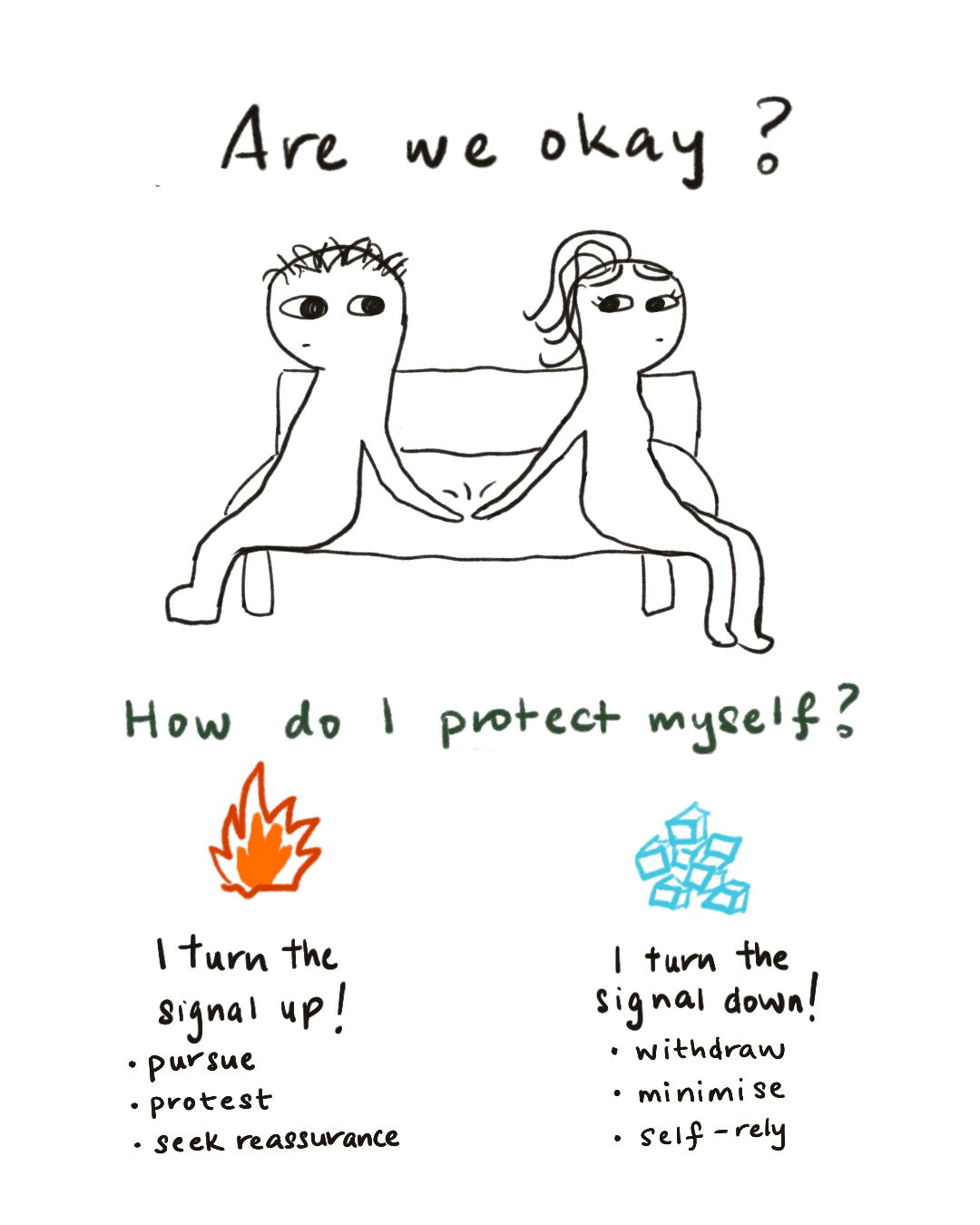
We might start protecting ourselves. And this is where what we commonly call attachment “styles” begin to show up.
Attachment “style” might not be the most useful way to think about it
In Emotionally Focused Couples Therapy, I find it more helpful to think in terms of attachment strategies.
Why?
Because a style can sound like something you are.
A strategy describes something you do.
It’s a set of tools your system has learned to navigate closeness, distance, uncertainty, rejection, and vulnerability.
Someone who becomes very anxious when their partner pulls away may begin seeking reassurance, checking for signs that something is wrong or pursuing harder for a conversation.
Someone else may deal with the same uncertainty by shutting down, focusing on themselves or trying not to need anything at all.
These are different strategies for dealing with the same fundamental problem: Connection no longer feels entirely safe. What can I do to fix it now?
The familiar attachment patterns
You will often see attachment described using four broad categories:
Secure attachment
Connection generally feels trustworthy. You can ask for support, respond to your partner and repair after things go wrong.
Anxious attachment
Distance or uncertainty can quickly feel threatening. You may seek closeness, reassurance or signs that the relationship is okay.
Avoidant attachment
Closeness, dependence or emotional intensity can feel uncomfortable or overwhelming. You may create distance, minimise your needs or rely heavily on yourself.
Fearful Avoidant attachment
You may deeply want closeness while also finding closeness frightening or difficult to trust. There can be movement between reaching for someone and pushing them away.
These descriptions can help us notice patterns.
You may not behave the same way in every relationship
Think about your own relationships in the past and present.
Have you always responded exactly the same way?
You may have been relatively relaxed with one partner but found yourself constantly seeking reassurance with another.
You may have been the person pursuing conversation in one relationship and the one shutting down in another.
Even within the same relationship, different situations can bring out different responses.
That’s because attachment doesn’t exist in isolation. It happens between people.
Whether you feel heard, valued, rejected, betrayed, wanted or emotionally safe matters. The strategy you reach for changes depending on how the relationship is.
The more useful question
Rather than asking, “Which attachment style am I?” Try:
“What do I tend to do when connection with someone important starts to feel uncertain?”

Those questions tell us far more about your relationships than a label alone.
And once you begin noticing your strategy, another question to ask is:
So what sets these strategies off?
Because most of us don’t behave this way all the time, something happens first and it lights something vulnerable in us.
Why do I become a different person during conflict?
Curious about couples therapy? Book a 20-minute complimentary call.
Book a complimentary call