
It usually starts with a threat to connection
Attachment becomes particularly powerful when someone important suddenly feels less available to us.
The moment itself might seem small from the outside.
Your partner sighs while you are talking.
They look at their phone.
They don’t make a comment about your food.
They tiredly say, “Can we talk about this later?”
But relationships are not experienced objectively. We interpret what happens.
A silence can mean You don’t care.
A criticism can mean I’m disappointing you again.
A request for space can mean You’re leaving me.
A partner’s distress can mean I can never get this right.
The event matters, but what it means to us often matters more.
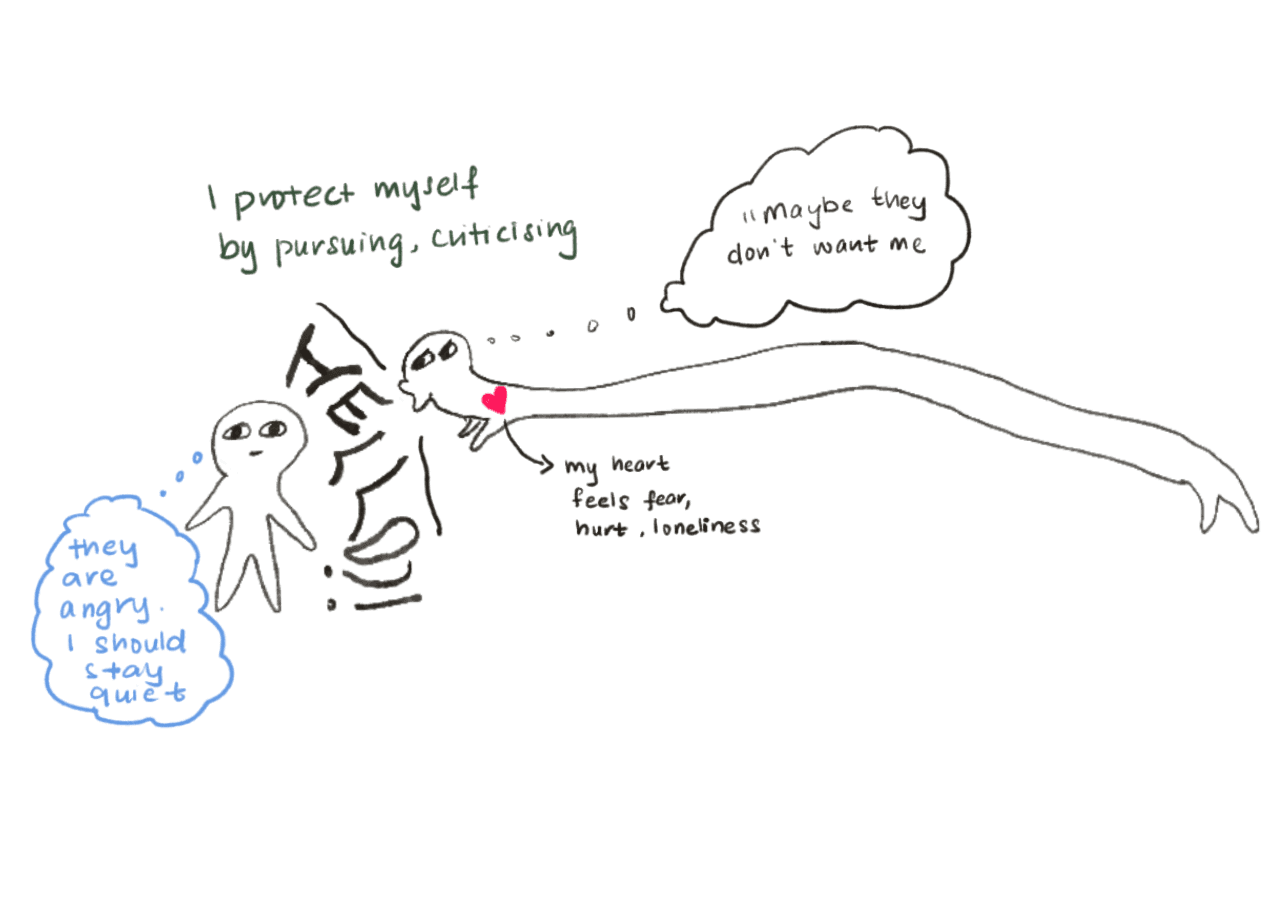
What your partner sees may not be what you’re actually feeling
Imagine one partner saying:
“You never care about anything I say.”
Their partner hears criticism.
But underneath that criticism might be:
“I tried to reach you and I didn’t feel you there.”
Or imagine someone saying:
“I don’t want to talk about this anymore.”
Their partner experiences rejection.
But underneath might be:
“I don’t know how to make this better, and every time we keep going I feel like I’m disappointing you.”
This is one of the central ideas in attachment-based couples therapy, including Emotionally Focused Couples Therapy. A systematic review of EFCT research is available through PubMed.
The protective response is often easier to see than the vulnerable experience underneath it.
Some of us turn the attachment signal up
When connection feels uncertain, some people move toward their partner.
- ask repeatedly what is wrong
- push to resolve the argument immediately
- seek reassurance
- become louder or more emotional
- criticise
- protest
- monitor changes in their partner
- find it difficult to let the issue go
 ask repeatedly what is wrong
In attachment language, these are often described as hyperactivating strategies.
Your system is essentially saying:
Something is wrong. Do something. Get closer. Get a response.
From the outside, it may look demanding.
From the inside, it can feel like desperately trying to restore connection. To matter.
Others turn the signal down
Other people respond to the same sense of threat by moving away.
- become quiet
- avoid the conversation
- minimise the problem
- focus on facts or solutions
- distract themselves
- need space or move away
- suppress what they are feeling
- convince themselves they should handle it alone
These are often described as deactivating strategies.
Your system is saying:
This is becoming too much. Turn it down. Get some distance. Protect yourself. Don’t make it worse.
From the outside, it may look uncaring.
From the inside, it can feel like the only way to prevent things from getting worse and maintain connection.
Neither response automatically tells you how much someone cares
The person pursuing the conversation does not necessarily care more.
The person withdrawing does not necessarily care less.
They may simply have learned very different ways of dealing with relational distress.
One amplifies the signal. The other dampens it. Both are trying to manage something difficult and painful.
And this is where couples often become trapped.
Try noticing the sequence before judging the reaction
The next time you notice yourself becoming activated with your partner, see whether you can slow the moment down enough to ask:
What just happened?
What did I immediately make it mean?
What did I feel before I became angry, defensive or distant?
What did I do to protect myself?
You don’t need to change it immediately.
Slowing it down prevents us from jumping to conclusions too quickly:
I’m too needy.
They’re emotionally unavailable.
We are just bad at communicating.
Because once you can see your reaction as part of a process, you can begin looking at what happens next.
What happens next is often where couples get really stuck.
Why do we keep having the same fight?
If you can already recognise this happening between you, couples therapy can help you slow these moments down and understand what is happening beneath the reaction, rather than only dealing with the argument after it has already escalated. Read more about our couples therapy approach, explore our therapy services, or Samantha’s practice.
Book a couples therapy